

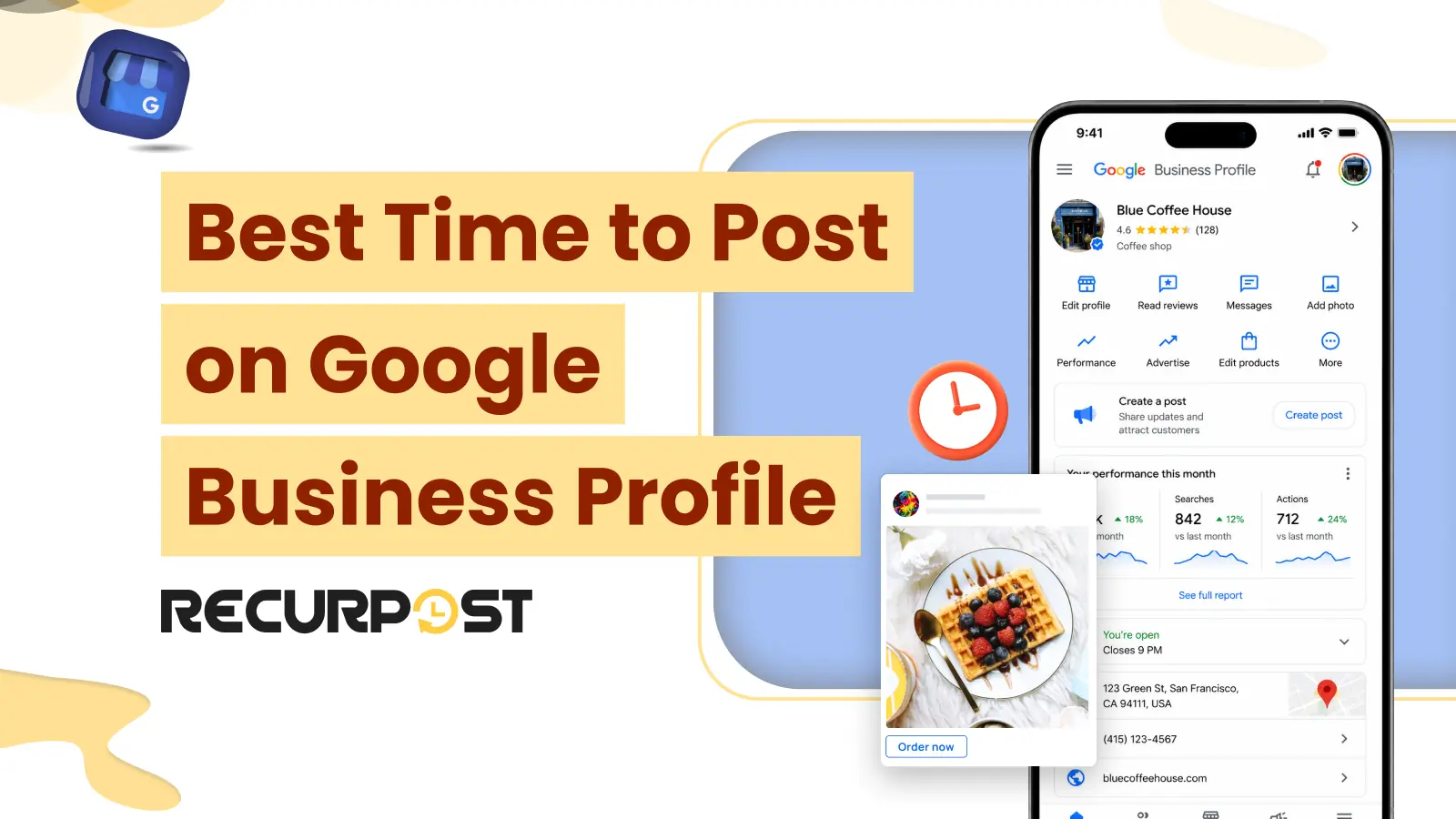
There is no single best time to post on Google Business Profile, and Google publishes no posting-hour guidance. Business Profile posts appear in Google Search and Google Maps when customers look up your business, so timing works differently than it does on a social media feed. The reliable way to find the best time is to test it for each location, using its local timezone, post type, customer demand windows, and its own Performance data.
This guide explains how Business Profile posts get seen, why we do not publish a universal posting hour, and how to run a four-week timing test for each location. It also shows how to schedule posts across multiple clients and multi-location profiles without logging into each one. Notably, Google Business Profile was known as Google My Business until 2022; therefore, you’ll still see references to Google My Business (GMB) in older articles and guides.
How Google Business Profile Posts Actually Get Seen

Google Business Profile posts appear on your Business Profile in Google Search and Google Maps. They do not appear in a scrolling social media feed. Customers can see your posts when they search for your business by name. They may also see them when your Business Profile appears for a local search, such as “dentist near me.” Unlike social media feeds, Google Business Profile does not rank your posts against thousands of others using an engagement algorithm.
This redefines what the “best time” means. On Google Business Profile, timing controls two things, namely:
- How fresh your post appears when customers view your Business Profile.
- Whether customers see your latest update while searching for your business.
Freshness matters because Google gives more visibility to your latest post and moves older posts lower after about a week. As a result, a Business Profile with only one old post can appear outdated or have an inactive posts section. On Google Business Profile, this is a bigger issue than posting during an off-peak hour.
For example, a five-location dental group’s last Google Business Profile update was published three weeks ago. Each Business Profile may still rank for “dentist near me.” However, the posts section appears empty or outdated, making the business look inactive to potential customers. The solution is to post consistently and to test timing per location, not to focus on finding one perfect hour.
Does Google Publish a Best Time to Post? What the Data Really Shows
Google doesn’t publish official best-time-to-post data for Google Business Profile. The day-and-hour charts you see elsewhere are usually built by agencies and tools that track when posts collect views and clicks. They are observational, they rarely name a sample, date range, business category, or geography, and they are not figures Google has published.
For that reason, this page does not give a universal day-and-hour table. A window that lacks a named dataset cannot be checked, and a window that worked for a restaurant in one city says little about a law firm in another. Treat any universal posting hour, including ones on other sites, as a hypothesis to test rather than a rule.
What you can rely on is the way customers use local search. People search for businesses while planning their day, deciding where to eat, or looking for a service they need soon. Timing a post around those demand windows for your own customers, and then checking the result in your Performance data, is more defensible than copying a chart.
How Demand Windows Differ by Business Type
The best time to post on Google Business Profile depends on when customers search for that type of business. Retail promotions, restaurant offers, service reminders, and holiday notices each map to a different customer moment. Use the table below to decide which demand window to test first, not as a list of proven posting hours.
| Post purpose | Customer moment | Demand window to test |
| Retail promotion | Shoppers deciding whether a sale is worth a visit | Just before the promotion starts, and again mid-promotion |
| Restaurant offer | People deciding where to eat | Ahead of the meal period the offer targets |
| Service reminder | Customers who need a service soon and want to call or book | Hours when your business can answer calls and bookings |
| Holiday or hours notice | Customers checking whether you are open | Several days before the holiday, plus a refresh close to it |
| Event announcement | Customers planning an outing | Early enough to plan around, then close to the event date |
Match the test window to your client’s business, not to another category. For example, a restaurant, a law firm, and a gym each need a separate schedule and a separate test, because their customers search at different moments.
Best Time to Post Each GBP Post Type

The best posting time depends on how long each Google Business Profile post type remains relevant. Google Business Profile offers four post types, and each one stays visible for a different period.
| Post type | Lifespan | When to publish |
| Update (What’s new) | Loses prominence after about 7 days | Weekly, to keep a fresh post on top |
| Offer | Runs until the offer end date you set | 2 to 3 days before the offer starts |
| Event | Stays until the event end date | 1 to 2 weeks before the event |
| Product | Persists on the profile until you remove it | Refresh monthly, no urgent timing |
Update posts lose freshness over time, so publish a new update every week to keep your posts section active. Offer and Event posts include their own end dates; therefore, schedule them before they begin and let them remain live until they expire.
For example, an agency schedules a weekly Update post alongside a month-long seasonal Offer post. This approach ensures the freshness of the business profile while promoting an ongoing campaign.
How to Find Your Own Best Time: A Four-Week Location Test
Your Google Business Profile Performance report is the right source for timing decisions, because it reflects your own customers. It shows how people find and interact with your Business Profile through searches, views, calls, messages, bookings, direction requests, and website clicks. Google documents these as metrics over a date range you choose; it does not document an hour-of-day view or results for each individual Update post. The test below therefore compares weeks against weeks, not hours against hours.
Run the test for each location separately and record the following in a worksheet:
| Field | What to record |
| Location and local timezone | The store or branch, and the timezone its customers live in |
| Business type | Restaurant, retail, service, healthcare, and so on |
| Post type | Update, Offer, or Event. Keep it the same across the test. |
| Publish day and local time | The exact day and the location’s local clock time |
| Demand window targeted | The customer moment the post is aimed at |
| Weekly Performance totals | Calls, direction requests, website clicks, and messages or bookings if you use them |
| Post link clicks | Clicks on the post’s call-to-action link, tracked with a UTM-tagged URL in your web analytics |
| Notes | Holidays, promotions, closures, or anything else that changes demand that week |
Then follow this rule for the four weeks:
- Choose two candidate publish times for the location, Window A and Window B, in its local timezone.
- Publish one post per week of the same type, with the same call-to-action, on the same day of the week. Use Window A in weeks 1 and 3 and Window B in weeks 2 and 4.
- After each week, allow a few days for Performance data to fill in, then record the weekly totals.
- Compare like with like: the two Window A weeks against the two Window B weeks, for the same location only. Ignore any week with a holiday, closure, or promotion that the other weeks did not have.
- Adopt a window only if it comes out ahead in both of its weeks. If the result is mixed, keep the current time and test a different pair.
For example, a regional retail chain manages stores in three time zones. Each store gets its own worksheet and its own local clock. Every store tests 9:00 AM local time against 1:00 PM local time, so the Pacific store is judged only against its own Pacific weeks, never against the Eastern store. Those two times are test values, not recommendations. If you manage several clients, keep a separate worksheet per client and repeat the test when hours, seasons, or offers change.
If you are managing a new Business Profile with no history, start with the demand window that matches its post purpose from the table above, then let the test decide.
Common Timing Mistakes on Google Business Profile
The worst time to post on Google Business Profile is not posting at all. An outdated posts section can make an active business appear inactive, which has a greater impact than posting during an off-peak hour.
Beyond that, these habits usually cost more than any choice of hour:
- Posting once and then stopping, which can leave the posts section outdated within a week.
- Scheduling posts in your own time zone instead of your client’s local time zone.
- Copying another business’s posting window without testing it on your own Business Profile.
- Changing the publish time, post type, and call-to-action all at once, so the test cannot show which change mattered.
None of these results in a penalty from Google. However, they reduce the value of the freshness window. For example, a profile may still rank in search results if a client only publishes one post at launch and never updates it again. However, incoming customers will see an outdated or empty posts section.
Schedule Google Business Profile Posts at the Best Time with RecurPost

RecurPost lets you schedule Google Business Profile posts in advance, so you can set each location’s local posting time and publish automatically. Connect your Business Profile, create a post with text, an image, or a video, and a call-to-action button. Once the post is ready, choose the posting time and add it to the queue. RecurPost publishes each post at the scheduled time across the Business Profile locations you manage.
RecurPost supports Google Business Profile call-to-action buttons, including:
- Call Now
- Learn More
- Sign Up
- Order Online
- Book
- Offer
You can add the appropriate button to each post while scheduling instead of updating every Business Profile manually.
Notably, three RecurPost features help agencies maintain a consistent posting schedule and run a location timing test:
- RecurPost keeps your weekly posting schedule organized in one content calendar, helping your updated posts stay consistent.
- RecurPost publishes the same or localized post across multiple Google Business Profile locations from one dashboard instead of requiring you to log into each profile.
- RecurPost documents 850+ platform errors, including cases where Google rejects a Business Profile post after initially accepting it, so scheduled posts don’t fail without notice.
For example, an agency managing 40 Business Profile locations can schedule a month’s worth of weekly updates from one calendar. Firstly, set the local posting time for each location. Consequently, queue the posts, and RecurPost will then handle publishing while alerting you of any publishing errors. Alternating Window A and Window B week by week is a matter of setting two different times in the queue.
RecurPost is a good fit for agencies and multi-location businesses that need to keep multiple Google Business Profiles active on a consistent schedule. It may be less suitable for a single-location business that publishes one post manually each week.
Try RecurPost
RecurPost’s Agency plan includes 20 social accounts and 3 users for $79/month, and additional teammates are $20 each. RecurPost bills per social account rather than per user seat, so costs stay predictable as you add client Google Business Profiles.
See RecurPost’s plans and pricing for all plans and add-ons, or start your 14-day free trial with no credit card required. You can connect your first location in the Google Business Profile post scheduler and schedule a week’s worth of posts in just a few minutes.
FAQs: Best Time to Post on Google Business Profile
1. What is the best time to post on Google Business Profile?
There is no universal best time to post on Google Business Profile, and Google publishes no official posting times. The best time is the one that works for each location, so run a four-week test in the location’s local timezone, compare like-for-like weeks in your Performance data, and adopt the window that comes out ahead.
2. How often should you post on Google Business Profile?
You should post on Google Business Profile at least once a week. Weekly posting helps keep a recent Update post visible on your Business Profile. Offer and Event posts remain active until their end dates. Therefore, you can schedule them alongside your weekly Update posts.
3. Do Google Business Profile posts expire?
Google Business Profile Update posts become less prominent after about 7 days and get pushed below newer posts. Offer and Event posts remain visible until the end date you set. Product posts stay on your Business Profile until you remove them.
4. Does posting time affect Google Business Profile ranking?
No, posting time doesn’t directly affect Google Business Profile rankings. Google Business Profile posts appear in Google Search and Google Maps when customers view your Business Profile, not in a ranked social media feed. Posting time mainly affects how fresh and visible your posts are. A consistent posting schedule helps keep your Business Profile active and can encourage customer engagement.
5. What is the best time to post on Google My Business?
Google My Business is now called Google Business Profile, and the answer is the same: there is no universal best time. Test posting windows for each location in its local timezone, using your Performance data to compare weeks, instead of relying on a fixed schedule. The tool’s posting behavior remained the same after the 2022 name change.
6. Can you schedule Google Business Profile posts in advance?
Yes, you can schedule Google Business Profile posts in advance with RecurPost. RecurPost lets you connect your Business Profile, add a call-to-action button, choose a publishing time, and schedule posts across multiple Business Profile locations. It also alerts you if Google rejects a post after initially accepting it, so scheduled posts don’t fail without notice.