Choosing between RecurPost vs Sked Social often comes down to how you run social media management across multiple social media platforms, how many accounts you handle, and whether your team needs approvals, inbox, and reporting in one place. Both are modern social media management tools, but they optimize for different working styles and different definitions of “scale.”
If you’re managing multiple clients or juggling multiple brands, the decision isn’t just about post scheduling. It’s about consistent workflows: planning in a visual content calendar, handling replies in a unified social inbox, and producing detailed reports with the right performance metrics to prove impact.
RecurPost vs Sked Social: Quick Comparison Overview
RecurPost and Sked Social both cover the foundation of social media scheduling tools: plan posts, schedule posts, and publish across major platforms. The bigger difference shows up when you compare the evergreen strategy, approvals, inbox coverage depth, and how each tool prices growth across multiple platforms.
At a high level, RecurPost leans into recycling evergreen content and recurring workflows, while Sked Social leans into collaboration-first operations (approvals, inbox, reporting) with “unlimited” packaging that appeals to teams with many stakeholders.
What is RecurPost?

RecurPost is a social media management platform built around scheduling, recurring posts, and a library-based system that helps maintain consistent posting with less manual work. It supports a planning-first workflow through a calendar, plus bulk tools and evergreen libraries designed to keep content rotating across social media channels.
If you’re researching similar social media tools, you can also review the RecurPost Alternatives page for context on where it fits among other social media management tools and scheduling platforms.
What is Sked Social?
Sked Social is a social media management tool focused on end-to-end publishing operations: planning and scheduling, approvals, collaboration, engagement via inbox, analytics/reporting, and newer social listening and link-in-bio tooling. It’s often described as “Instagram-first” historically, but current positioning emphasizes multi-channel workflow and stakeholder-friendly approvals.
If you’re comparing against other social media management tools, the Sked Social Alternatives page is a useful reference point to evaluate comparable workflow-first platforms.
RecurPost vs Sked Social Comparison Table
Before you go deep, this table summarizes the “day-one” differences many teams notice when handling multiple clients and multiple accounts.
RecurPost’s plans start at $9/month and include recurring scheduling from the entry tier, with add-on profiles priced explicitly. Sked Social’s base prices start at US$59/month and emphasize unlimited users, unlimited posts, and unlimited analytics across plans.
| Category | RecurPost | Sked Social |
|---|---|---|
| Positioning | Evergreen-first scheduling + libraries | Collaboration + approvals + reporting bundle |
| Starting price (base) | $9/month (Starter) | US$59/month (Launch) |
| Trial | 14-day, no credit card mentioned on pricing | 14-day free trial mentioned |
| Users | Not positioned as “unlimited users” on pricing | “Unlimited Users” emphasized |
| Evergreen content | Core differentiator (libraries + recurring) | Not positioned as the core differentiator |
| Approvals | Included at the Agency tier with internal/external workflows | No-login branded approval portal + customizable workflows |
| Inbox | Unified inbox marketed; coverage varies by platform | Defined inbox interaction coverage across key networks |
| Social listening | Not positioned as a core module | AI-driven sentiment + competitor benchmarks (up to 20) |
| Reporting | Agency+ analytics + white-label reporting positioning | “Unlimited analytics” + shareable dashboards + exports |
RecurPost vs Sked Social Features Comparison
Both platforms cover essential content scheduling and calendar planning, but they prioritize different “power features.” For RecurPost, the standout is the repeatable engine of evergreen content plus recurring posts across accounts.
For Sked Social, the standout is workflow: approvals, inbox, and reporting designed for teams and stakeholders, with strong emphasis on advanced format support and collaboration without seat fees.
Core Features Overview
At the core, you’ll find scheduling, a calendar view, and tools to plan posts across multiple social media platforms. Both also support bulk scheduling, which matters when you’re onboarding new brands, launching campaigns, or migrating content libraries.
Where they diverge is how each tool treats operations at scale. RecurPost is designed to keep publishing steady through reuse, while Sked Social is designed to keep teams aligned through approvals, inbox workflows, and reporting that’s easy to share.
RecurPost Key Features

RecurPost’s key features include evergreen content libraries (content recycling), bulk scheduling via CSV/bulk upload, and RSS feed importing for ongoing content sourcing. This supports a “load once, reuse many times” strategy that fits businesses focused on long-term visibility and steady cadence.
It also supports a calendar workflow plus plan-level additions like workspaces, approval workflows, and analytics reports for teams that grow into multi-client operations. For agencies, that combination can be especially practical when managing multiple accounts under consistent governance.
Sked Social Key Features

Sked Social’s key features emphasize collaboration: customizable approval workflows, a no-login branded approval portal, and unlimited users positioned as a core pricing philosophy. This is tailored to teams that need fast review cycles, clear feedback, and fewer bottlenecks.
It also highlights advanced auto-publishing coverage (including Instagram Stories with stickers and other format-heavy publishing) and a unified inbox designed for engagement management across brands. For teams that handle many reviewers, Sked’s packaging can reduce friction.
Unique Features: RecurPost vs Sked Social
RecurPost stands out most when the evergreen strategy is central: recycling evergreen content through libraries, controlling rotations, and using recurring scheduling to keep a steady presence. That can be a clear efficiency win when content themes repeat (FAQs, testimonials, tips, promotions) across months.
Sked Social stands out most when approvals and stakeholder workflows are central, especially with external clients who don’t want new logins. If your day involves client sign-off, brand compliance, and structured collaboration, Sked Social shines in those process-heavy requirements.
Analytics and Reporting Capabilities
Analytics is where teams often feel the difference between “basic visibility” and advanced analytics with stakeholder-ready outputs. Sked emphasizes unlimited analytics and reporting exports, plus sharing analytics via URLs for clients to view without back-and-forth.
RecurPost’s analytics is more tightly coupled to its evergreen workflow, including performance signals that can help you refine libraries and repeat what’s working. For teams that measure content by category or library, this can feel more actionable than dashboards that only show channel totals.
RecurPost Analytics Tools
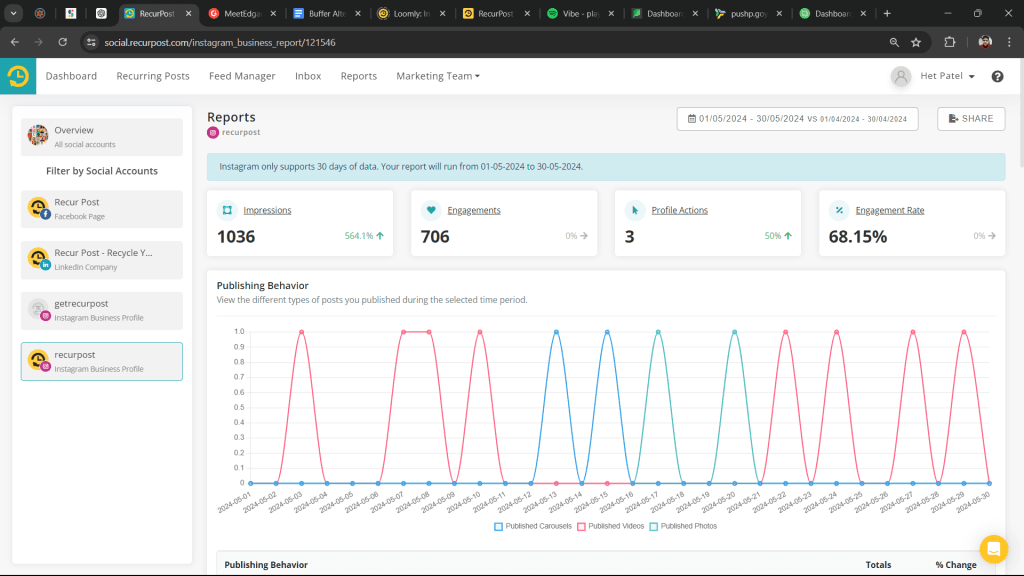
RecurPost markets a reporting suite that includes engagement-by-platform, engagement-by-library, and top-post analysis, aligning well with how teams run recurring and evergreen cycles. This is a practical fit when you want to track performance by content bucket, not just by channel.
It also positions sharable and white-label reporting as part of the agency toolkit, which matters for managing multiple clients and presenting results under your own branding. Advanced analytics availability can vary by plan, with analytics reports bundled at Agency+ in plan messaging.
Sked Social Analytics Tools

Sked Social claims channel, post, and follower analytics, plus “advanced” metrics like engagement rate and deeper Instagram detail, including Stories and performance by story type. It also highlights demographics and best-time recommendations, which support more data-driven planning.
On reporting, Sked emphasizes one-click PDF reports, custom reports with AI commentary, Excel exports, and shareable view-only dashboards. If your stakeholders expect polished, client-friendly deliverables, that reporting package can reduce time spent building decks manually.
User Interface and Ease of Use: RecurPost vs Sked Social
Both tools offer modern planning experiences, but they “feel” different in daily use. Sked leans into a drag-and-drop interface and planner-style workflows that resemble project management, which can be intuitive for teams that live in calendars.
RecurPost leans into a library-and-reuse workflow, which is often simpler once set up, but different from a purely calendar-first approach. If your team has never used evergreen libraries, there can be a short adjustment period before it becomes second nature.
Interface Design Comparison
Sked’s design focuses on visual planning, approvals status, and collaboration layers, which helps when many people touch the same calendar. That structure can make it easier to see who needs to review what, and when content is ready to publish.

RecurPost’s interface emphasizes content organization and repeatability, especially through libraries and recurring schedules. For teams that publish evergreen content frequently, this reduces repetitive drafting and supports a consistent cadence with fewer moving parts.

Learning Curve and User Experience
Sked can feel user-friendly for teams used to approvals and campaign workflows, but it may still carry a steep learning curve for solo users who only want a scheduler. The breadth of approvals, inbox, analytics, and listening means onboarding should include workflow design, not just “connect accounts and post.”
RecurPost can be faster for solo users or small teams because the core flow is straightforward: organize content, set recurring slots, and reuse evergreen assets. Once libraries are built, the day-to-day workload often shifts from constant creation to lighter optimization and engagement checks.
Mobile App Functionality
Mobile matters most when you rely on quick reviews, last-minute edits, or on-the-go engagement management. Sked’s mobile update cadence has historically been less prominent than its web experience, so mobile-dependent teams should test approvals and publishing notifications during trial.
RecurPost positions mobile as part of the workflow for monitoring, approvals, and publishing actions tied to platform constraints. If your team needs quick checks across multiple clients, a functional mobile workflow reduces delays when stakeholders aren’t at a desk.
Team Collaboration Features
Collaboration is where tools separate “scheduler” from “system.” If you’re handling multiple clients, you’ll care about approvals, stakeholder visibility, and how easily you can add collaborators without blowing up costs.
Sked’s pricing narrative explicitly challenges seat-based pricing and emphasizes unlimited users. RecurPost’s collaboration features are more plan-gated but can still support agency workflows through workspaces and approvals.
Workflow Management and Approval Processes
Sked Social offers customizable approval workflows and explicitly markets rules, such as “publish only if approved,” which reduces accidental posting. For agencies, the external no-login portal can streamline client feedback without adding friction for reviewers.

RecurPost includes internal and external approval workflows at the Agency tier, which can support client sign-off without adopting a heavyweight governance suite. The difference is that RecurPost’s approvals typically feel like a step-up feature for growing teams, rather than the center of the platform’s identity.

Role-Based Permissions and User Management
Sked Social emphasizes collaboration without a seat tax, which can be attractive when many users need visibility for strategists, designers, account managers, and clients. That setup supports fast reviews when multiple stakeholders are involved across multiple workspaces or brands.
RecurPost is more profile-and plan-oriented, which can be easier to budget for when agencies scale by accounts rather than headcount. It also supports role-based access in team workspaces, but you’ll typically consider it once approvals and reporting become essential parts of delivery.
Team Communication Tools
Sked’s approach leans into built-in collaboration layers: approvals, comments, statuses, and stakeholder-ready visibility. That can reduce ad-hoc messaging and keep feedback attached to the post rather than scattered across chat threads.
RecurPost’s team communication is usually more lightweight and operational: organize work, assign tasks in inbox contexts, and move content through review when needed. For teams focused on efficiency, lighter workflows can mean fewer steps and less administrative overhead.
RecurPost vs Sked Social for Content Management
Content management is not just “posting”, it’s how you store assets, reuse ideas, and scale a content engine across multiple platforms. Teams that rely on evergreen strategies will evaluate this section very differently from teams running short-lived campaign bursts.
Sked provides robust planning and collaboration layers for content production, while RecurPost provides a systemized approach to evergreen reuse. Your choice depends on whether your bottleneck is creation/approval or long-term consistency.
Content Scheduling and Publishing
Both tools support scheduling across major platforms, and both cover core post-scheduling needs. Sked also highlights “advanced auto-publishing” for formats like Instagram Stories with stickers, which is relevant for format-heavy workflows.

RecurPost supports recurring and one-off scheduling from the entry plan, plus best-time scheduling and platform-specific customization in higher tiers. If your strategy depends on keeping evergreen posts cycling, this is where RecurPost’s workflow becomes a daily advantage.
Content Library and Asset Management
RecurPost’s defining feature is the content library model, where evergreen posts live in categories and recycle automatically over time. That reduces repeated drafting and makes it easier to maintain consistent posting even when your team is busy.
Sked’s asset approach is more aligned with planning and stakeholder review, including media handling and content production workflows. If your process involves designers, reviewers, and iterations, Sked’s organization can feel closer to a creative ops hub than a simple scheduler.
Multi-Platform Support
Sked lists auto-post support across Instagram, Facebook, TikTok, LinkedIn, X/Twitter, Threads, Pinterest, YouTube, and Google Business Profile, with Snapchat handled via notification workflows. This breadth helps agencies running multi platform support without stitching together multiple tools.
RecurPost also supports a broad set of platforms, including Instagram, LinkedIn, X, Pinterest, Google Business Profile, TikTok, YouTube, and Threads, with some formats depending on direct publish vs push constraints. For teams managing multiple accounts, that platform coverage supports a consolidated workflow under one calendar.
Social Media Management Capabilities
“Social media management” includes more than scheduling: it includes monitoring, engagement management, and sometimes social listening. If your team’s value is tied to responsiveness and community, inbox and monitoring features become a core requirement.
Sked Social leans into engagement and listening as first-class modules, while RecurPost leans into scheduling + inbox + reporting as a practical baseline. The best fit depends on whether you need deeper listening or a streamlined publishing engine.
Social Listening and Monitoring Tools
Sked positions social listening as “powerful” yet “made simple,” emphasizing brand sentiment tracking, audience analytics, competitor benchmarks, and presentation-ready reporting. If you need to listen to guide social media strategies, this can reduce reliance on separate listening platforms.
RecurPost is not positioned as a dedicated listening suite in the same explicit way, so teams with strict listening requirements should validate what “monitoring” means in practice. In many cases, brands use RecurPost for execution and pair listening with a specialist tool if needed.
RecurPost Listening Features
RecurPost’s strengths skew toward publishing workflows, evergreen scheduling, and reporting rather than a fully documented listening engine. For many teams, that’s fine because listening is a separate discipline with separate tooling needs.
If your definition of listening is “stay aware of responses and manage engagement,” RecurPost’s inbox and reporting can support the operational side. If your definition is sentiment and competitive benchmarking, it’s smart to validate capabilities before you commit.
Sked Social Listening Features
Sked’s listening page highlights brand sentiment, cross-channel audience analytics, and competitor tracking up to 20 rivals, presented as shareable benchmarks. It also emphasizes AI-enabled analysis and custom reports designed to be presentation-ready.
Sked also notes listening availability for new plans, which signals it’s part of the product’s modern bundle rather than an optional add-on. If listening is central to your reporting narrative, this positioning can matter for stakeholder expectations.
Engagement and Response Management
Sked’s inbox coverage is clearly defined across key interaction types like Instagram DMs and comments, Facebook page messages and comments, TikTok comments, LinkedIn company engagement, and Google Business Profile reviews/questions. That clarity helps teams plan customer care workflows and response SLAs.

RecurPost markets a unified inbox and collaboration features like assignment and labels, which can work well for lightweight routing. If your engagement workload is moderate, that may be enough without adopting a heavier customer support platform.

Social Media Management Tools Compared
If your daily work centers on engagement management, Sked’s explicit inbox list and stakeholder workflows reduce uncertainty. You’ll spend less time asking “does it support this interaction type?” and more time executing responses and reporting results.
If your daily work centers on steady publishing and evergreen reuse, RecurPost’s library approach creates a predictable content system. That’s especially useful when you manage multiple clients and need a repeatable operational model across accounts.
Marketing and Automation Features
Marketing features matter when social is part of a broader funnel: campaigns, attribution, and workflows that save time. In 2026 planning, “automation” often means more than posting; it includes reusable systems and content operations that don’t break under scale.
Sked’s automation story is tied to approval rules, analytics sharing, and AI assistance across modules. RecurPost’s automation story is tied to evergreen recycling and reducing repetitive manual scheduling.
Campaign Management Tools
Sked supports campaign-style organization through planning, labels, and stakeholder workflows that help teams coordinate multi-post initiatives. If you run structured campaigns across multiple platforms, that organization helps keep timing and feedback aligned.
RecurPost supports campaign execution well when campaigns include reusable themes, recurring series, or ongoing promotions. The ability to recycle high-performing evergreen assets can improve audience growth over time without restarting from scratch each month.
Marketing Analytics
Sked focuses on reporting that’s easy to ship: PDFs, exports, shareable dashboards, and AI commentary in custom reporting. That can reduce reporting time for agencies and improve stakeholder clarity for decision-making.

RecurPost’s analytics is particularly useful when you want to link results back to content libraries and recurring strategies. Measuring “what works by library” can make optimization more systematic, especially when you run evergreen sequences across different clients.

Automation Capabilities
Sked’s automation is strongest in workflow rules like “publish only if approved,” plus template-driven inbox efficiency and AI support across reporting and listening. It’s designed to streamline operations rather than fully automate engagement responses.
RecurPost’s automation is strongest in content operations: import in bulk, organize into libraries, and recycle automatically with recurring schedules. For teams that want a predictable publishing system, that approach often delivers compounding time savings.
Integrations and Platform Compatibility
Integrations determine whether your scheduler fits your existing content stack. For many teams, the essentials are creative tooling (like Canva), automation connectors (like Zapier), and storage sources (like Google Drive).
Both tools cover common needs, but they highlight different ecosystems. Sked emphasizes a bundle of integrations visible on pricing pages, while RecurPost highlights a smaller set of “first-class” integrations plus built-in import paths like CSV and RSS.
Native Integrations Comparison
Sked’s integration messaging highlights creative and storage workflows, which support teams producing high volumes of visual content. RecurPost’s integration messaging is often paired with content reuse and publishing efficiency rather than creative ops management.
In practice, both tools can connect with popular platforms, but the best choice depends on whether your workflow is “design-heavy collaboration” or “evergreen publishing efficiency.” That distinction becomes more obvious as you scale across multiple clients.
RecurPost Integrations

RecurPost highlights integrations like Canva, Zapier, and Bitly as core connections, which cover many standard workflows for content creation and automation. These integrations matter most when you’re creating content quickly, shortening links, and routing tasks across tools.
RecurPost also emphasizes built-in import tools like CSV bulk scheduling and RSS feed importing, which can reduce dependence on third-party systems. For evergreen workflows, those native import paths can be as valuable as “integration counts.”
Sked Social Integrations

Sked highlights integrations with key social platforms and tools like Canva, Google Drive, Dropbox, Zapier, and Frontify in its integration strip on pricing. That’s a strong fit for agencies that manage large asset libraries and multiple reviewers.
Sked’s ecosystem also supports publishing breadth across major networks and workflow tooling like link-in-bio, which is included as part of the platform. If you want a single workspace that covers planning through reporting, those bundled integrations can reduce tool sprawl.
Third-Party Apps and API Access
Both tools can extend to other systems through connectors, especially via automation platforms. For many businesses, that’s the simplest way to connect scheduling tools with CRMs, content repositories, or task management.
If API access is critical for custom workflows, validate this during evaluation because public API positioning varies by vendor. In many cases, teams achieve what they need via Zapier-style integrations without maintaining custom API pipelines.
RecurPost vs Sked Social Pricing and Plans
Pricing is one of the clearest differences in RecurPost vs Sked Social. RecurPost’s paid plans start at $9/month, while Sked Social’s paid plans start at US $59/month, and the pricing philosophies differ meaningfully.
Sked emphasizes unlimited users and bundles, then charges primarily by social accounts. RecurPost emphasizes lower entry price, explicit per-profile add-ons, and plan-gated capabilities like analytics and approvals as you move up tiers.
RecurPost Pricing Tiers
RecurPost lists Starter at $9/month, Personal at $25/month, and Agency at $79/month on monthly pricing, with a 14-day trial and “no credit card needed” messaging. It also lists “Extra $4 each” for additional social profiles on plans.
This structure is often cost-effective for agencies that scale by profiles rather than seats, especially when you need recurring posts and evergreen libraries early. It’s also easier to model when budgeting for multiple brands because the per-profile add-on is explicit.
Sked Social Pricing Tiers
Sked Social shows Launch at US$59/month, Grow at US$149/month, and Accelerate from US$399/month, with included accounts and additional account pricing called out. It also promotes unlimited users, unlimited posts, and unlimited analytics as part of the value narrative.
For teams with many collaborators, this “unlimited users” approach can be attractive because it avoids per-seat compounding costs. The tradeoff is a higher base price, which can be less accessible for small teams that primarily need scheduling and lightweight reporting.
Free Trial and Free Plans
Both tools promote trials rather than positioning a permanent free tier as the primary entry point. RecurPost highlights a 14-day trial, with “no CC required,” and a money-back guarantee noted on pricing.
Sked Social highlights a 14-day free trial and positions many “included” capabilities (inbox, analytics, AI) as available across plans. If a free plan is essential, you should confirm current availability directly, since the public positioning emphasizes trial-led onboarding rather than a free plan.
Value for Money: Which Offers Better ROI?
ROI depends on whether you need collaboration breadth or evergreen efficiency. If you get value from unlimited users, a no-login portal, and reporting exports that save hours, Sked’s pricing can justify itself for process-heavy teams.
If you get value from reducing content production workload through recycling evergreen content, RecurPost often delivers a strong ROI because recurring workflows reduce repeated effort. For agencies that run repeatable content frameworks across clients, this can be a more efficient baseline than paying primarily for workflow layers.
Customer Support and Resources
Support matters when you’re connecting many social accounts, handling approvals, and shipping client reporting on tight timelines. A tool can be feature-rich, but slow support can turn small issues into missed posting windows.
Sked positions “human support” prominently in pricing messaging, while RecurPost has strong support sentiment reflected in recent review signals referenced in research. For agencies, responsive support is part of operational risk management.
Support Options and Response Times
Sked Social explicitly promotes 24/7 human support via chat, Zoom, and email, framing it as an alternative to chatbot-only support. That’s especially relevant when agencies operate across time zones or manage high-stakes client calendars.

RecurPost support is often described in a “real humans” framing in independent feedback referenced in the research, with a verified review noting responses within 12 hours. For many SMBs, that responsiveness is “fast enough” while keeping costs lower than enterprise tools.

Training, Onboarding, and Documentation
Sked’s workflow depth means onboarding should include approvals setups, permissions, and reporting structures, not just scheduling. Teams that invest in setup typically get smoother collaboration once the system matches their approval workflows.
RecurPost onboarding tends to focus on building content libraries, importing assets, and setting recurring slots. Once your evergreen engine is organized, ongoing maintenance becomes lighter and easier to delegate across team members.
Community and User Resources
Sked offers a help center and resources hub that support workflow adoption, especially for agencies that need standardized processes. Community resources can also help teams adopt consistent naming, labels, and approval statuses across clients.
RecurPost provides educational resources and free tools (like templates and generators) that can be useful for teams building consistent posting habits. For small businesses, those resources can reduce reliance on external training while still improving strategy execution.
RecurPost vs Sked Social: Which Should You Choose?
There isn’t one universal answer because RecurPost vs Sked Social depends on whether your bottleneck is content volume or collaboration complexity. Many teams benefit from listing their “must-have” requirements for accounts, approvals, inbox, and reporting before comparing UI.
As a shortcut: choose Sked when approvals and stakeholder workflows are the product, and choose RecurPost when evergreen publishing efficiency is the product. Your decision becomes clearer when you map features to weekly workload realities.
When to Choose RecurPost
Choose RecurPost when you want a system for recurring posts and evergreen content that keeps publishing consistently without constant manual scheduling. This is especially useful for SMBs, creators, and agencies that reuse proven content themes across months.
RecurPost also fits teams who want predictable costs as they add multiple accounts, because plan tiers and extra profile pricing are clearly stated. If you’re managing multiple clients with repeatable content frameworks, this model is often simpler to operate.
When to Choose Sked Social
Choose Sked Social when you need collaboration at scale: many users, external approvals, and reporting deliverables that look client-ready with minimal extra work. The no-login branded approval portal is a meaningful advantage for agencies that want frictionless client sign-off.
Sked is also strong when you need explicit engagement coverage (e.g., defined inbox interaction types) and newer social listening features like sentiment and competitor benchmarks. If your client’s deliverables include listening insights, Sked’s positioning may align better with expectations.
Key Decision Factors for Your Business
Start with your operating model: are you optimizing for publishing efficiency or stakeholder coordination? If your team spends more time creating and rescheduling than reviewing, evergreen automation can deliver faster wins.
Then look at reporting expectations: do you need deeper analytics and custom reports that are stakeholder-ready, or do you mainly need actionable performance checks to optimize content categories? Matching reporting style to stakeholder needs prevents tool churn later.
Better Alternatives to Consider [RecurPost, of course]
If you want a more evergreen-first alternative that’s often easier to run for consistent posting across multiple platforms, RecurPost is a strong baseline. Its library system, bulk scheduling, and recurring approach can reduce content workload while still supporting agencies via workspaces, approvals, and reporting as you scale.
If you want other points of comparison, Sprout Social is often evaluated for enterprise-grade workflows and smart inbox experiences, while other tools focus on lightweight scheduling. Still, for many teams, the practical question is whether you need an enterprise suite or a repeatable system that delivers consistent execution without excess overhead.
RecurPost vs Sked Social FAQs
These FAQs address the most common decision blockers buyers have when comparing social media management tools. Use them to sanity-check your shortlist against budget, workflow complexity, and platform needs.
Because tools evolve, it’s also smart to validate a few high-impact items during trial: inbox interaction coverage, approvals flow, and whether analytics outputs match client expectations. That testing often reveals fit faster than feature lists.
Is RecurPost or Sked Social better for small businesses?
Small businesses often benefit from RecurPost when they need consistent posting and a repeatable, evergreen system without high monthly costs. The Starter and Personal tiers are designed for lower-cost entry while still supporting recurring scheduling and core workflows.
Sked Social can still work for small businesses, but it tends to make more sense when collaboration, approvals, and reporting outputs are central needs. If you’re a solo operator who mainly wants scheduling, Sked’s breadth may feel like more system than you need.
Which social media management tool is more affordable?
Based on published base pricing, RecurPost is more affordable at entry, starting at $9/month compared with Sked Social starting at US$59/month. That gap can matter a lot for freelancers and small teams managing only a few social accounts.
However, affordability also depends on how many users you need. If you’d otherwise pay per seat in other tools, Sked’s “unlimited users” model can shift the affordability equation for larger teams or agency-client collaboration.
Can I switch from Sked Social to RecurPost?
Yes—switching is feasible. The main work is moving your scheduled content (captions, media, posting times) and rebuilding your workflow in RecurPost using its bulk scheduling and content library for recycling evergreen content.
If you rely heavily on Sked’s approval workflows and post statuses, set up RecurPost’s team approvals/user permissions (usually on higher plans) and migrate in stages—one brand or a few social accounts first—before moving all multiple accounts and multiple clients.
Which has better customer support?
Sked highlights 24/7 human support via chat, Zoom, and email directly in its pricing messaging. That’s a strong promise for agencies that need help outside standard business hours.
RecurPost is frequently associated with responsive support sentiment in review-based research signals, including “real people” support experiences. If fast, human support is critical, validate response channels during trial for both tools.
Do RecurPost and Sked Social offer free trials?
Yes, both tools promote free trials on their pricing pages. RecurPost highlights a 14-day trial with “no credit card needed” messaging, while Sked highlights a 14-day free trial as the primary way to get started.