

Orbital Media publishes video, podcast and social content across twelve destinations from Franklin Lakes, New Jersey. Founder John C. Morley lost 6 to 8 of those posts every week to publishing failures spread across several schedulers. Sixty days after moving that calendar onto RecurPost, John reports failures fell to nearly zero per month. RecurPost produced that change through one mechanism, and it did not remove every kind of failure.
posts lost every week to publishing failures before the switch
failed posts per month after 60 days, reported by John C. Morley
published destinations across 5 networks, half of them YouTube channels
| What changed | Before RecurPost | After 60 days |
|---|---|---|
| Failed posts | 6 to 8 per week | Nearly zero per month |
| Publishing tools in use | Several schedulers plus manual uploads | One platform |
| Scheduling effort | Hours across multiple tools | Minutes in one tool |
| Podcast promotion cadence | Irregular | Daily and on time |
| Published destinations | 12 across 5 networks: 1 Facebook Page, 2 Instagram accounts, 6 YouTube channels, 2 LinkedIn destinations, 1 TikTok account | Unchanged |
Figures in the first four rows are John C. Morley’s, reported for his own operation.
John C. Morley describes the change in his own words: watch the Orbital Media testimonial.
What Orbital Media Publishes, and Where
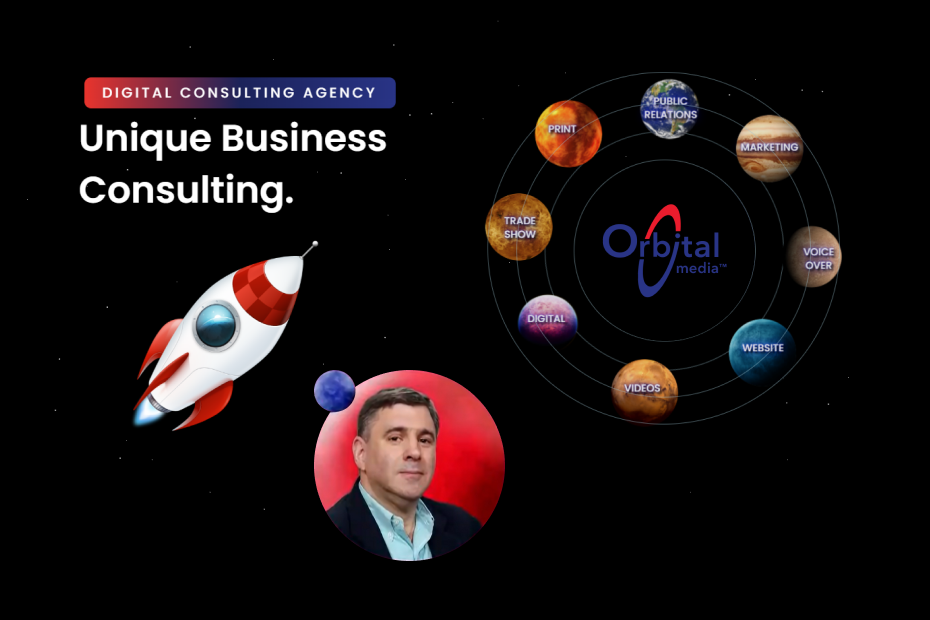
Digital consulting agency: PR, marketing, print, digital, web, video, trade show and voice-over
Franklin Lakes, New Jersey
2011, by John C. Morley
Orbital Media operates as a digital consulting agency in Franklin Lakes, New Jersey, covering public relations, marketing, print, digital, website, video, trade show and voice-over work. John C. Morley founded Orbital Media in 2011 and also runs The JMOR Connection, Inc., a technology firm he started in 1994. John describes the studio as producing for several in-house brands alongside external clients.
Orbital Media and John’s related brands publish to 12 destinations across 5 networks: one Facebook Page, two Instagram accounts, six YouTube channels, two LinkedIn destinations and one TikTok account. Orbital Media’s destination set puts half of those twelve on YouTube. RecurPost connects the primary channel of the signed-in Google account, so a six-channel operation needs six separate sign-ins rather than one YouTube connection.
The two Instagram accounts alone carry 3,376 published posts between them, 2,232 on the Orbital Media Hub account and 1,144 on John’s personal brand account. At that volume, six to eight failures a week is a steady leak, not an occasional glitch.
Orbital Media has not published which of those twelve destinations it connected to RecurPost. The set above is what the business publishes, verified from its own profiles.
This arithmetic matters when one operator holds a single calendar across brands that share no accounts. A single brand running two or three accounts never meets that setup cost, and RecurPost’s per-channel rule stays invisible to it. Anyone weighing a YouTube-heavy operation should read how RecurPost handles the platform for scheduled YouTube videos.
What Was Failing Before RecurPost
Orbital Media lost 6 to 8 posts a week to publishing failures while running several schedulers plus manual uploads. John C. Morley reports that the failures broke campaign momentum on accounts his clients could see. Rising costs on the previous platform gave him a second reason to move.
Several schedulers running in parallel left Orbital Media with no single failure queue. A post that died inside one tool stayed invisible from the others, which is why the count held at 6 to 8 instead of being caught and corrected each week.
A client who spots the missing post before the agency does turns a publishing error into a trust problem. That is the real cost at agency volume, and it is why a failure rate this size does not stay a scheduling inconvenience for long.
This pattern shows up wherever one operator publishes to client-visible calendars on a daily rhythm. An operation posting occasionally, with nobody checking the queue, never feels it.
How RecurPost Brought the Failure Rate to Nearly Zero
RecurPost detects more than 850 documented platform errors and keeps every failed post visible with a named cause. A failure surfaces as an expired access token or an image specification rejection, not as a raw API code, so the operator can see what to fix without decoding it.
RecurPost pairs that catalogue with retry from the History view and a one-click reconnect for expired tokens. On Google Business Profile, RecurPost goes further and re-checks published posts at roughly 30 minutes and 6 hours, which catches posts Google accepts and then silently rejects. The full set of documented failure types sits in RecurPost’s documented publishing errors.
RecurPost put all of Orbital Media’s destinations behind one queue. A failure now surfaces in the same place the post was scheduled. RecurPost’s single queue did the structural work here, and no individual setting explains the number on its own.
John C. Morley reports failures fell from 6 to 8 a week to nearly zero a month over 60 days. RecurPost’s error catalogue is documented product behaviour. The first figure is his result under his conditions. The second is what the product does for any account connected to it. RecurPost’s wider publishing toolset is listed under RecurPost publishing features.
Failure handling pays off where posting is daily and client-visible. A weekly poster on one account rarely sees the catalogue do anything, because the failure surface is too small to test it.

The Scheduling Routine Behind a Daily Cadence
RecurPost publishes each post on the schedule attached to its content library, at the frequency and times Orbital Media sets rather than a slot chosen post by post. John C. Morley uses that to keep daily promotion running for The JMOR Tech Talk Show, which broadcasts live on Friday evening and releases audio on Saturday. A fixed weekly production rhythm gives RecurPost a predictable promotion window to fill.
RecurPost generates platform-specific hashtag suggestions per network, so a YouTube description and an Instagram caption do not carry the same tag block. RecurPost’s social inbox then collects comments and messages from the connected accounts in one view, with AI-drafted replies available for the routine ones.
Evergreen recurring libraries for the promotion set
RecurPost’s evergreen recurring libraries keep a post looping at a set frequency until it is deleted. Orbital Media uses them for videos, press releases and articles that stay true after their publication date.
Orbital Media keeps its dated promotions and live-show announcements out of those libraries and on a one-off schedule instead.
What RecurPost Did Not Remove
RecurPost cannot stop a platform from expiring an access token. Every connected account carries a reconnection cycle set by the platform, not by RecurPost, and an account that nobody reconnects will still drop posts.
RecurPost publishes to Instagram Business and Creator accounts automatically. An Instagram personal profile receives a mobile reminder instead of an automatic post, so a personal profile in the mix keeps one manual step in the routine.
RecurPost cannot schedule YouTube community posts, live streams or Premieres, and neither can any other tool. LinkedIn Articles and polls sit outside every scheduler’s reach for the same reason: the platforms have not opened those formats.
RecurPost converted unpredictable failures into predictable maintenance for Orbital Media. RecurPost turned setup and reconnection work into a scheduled task instead of a discovered failure, and that is the honest version of the result.
RecurPost’s trade of surprise failures for scheduled maintenance works where someone owns the account reconnection. It does not work where nobody does, because an expired token will still cost posts on schedule.
Who This Setup Fits
This setup fits a studio holding one calendar across brands whose accounts do not overlap. Orbital Media’s twelve destinations across five networks, published on a daily rhythm, are the shape it was tested on.
The setup fits harder where calendars are client-visible, because a silent failure becomes a client conversation rather than an internal note. RecurPost’s consolidation pays for itself at double-digit destination counts, where a split stack costs more in checking than in licence fees. One or two operators can run it without a long approval chain, and RecurPost supports per-post approval when a chain is needed.
A single brand posting a few times a week will not test any of this. Reliability barely registers at that volume. Teams whose main need is reactive, same-day posting should look elsewhere, since a planned calendar is the premise here. And an operation with nobody assigned to account reconnection will keep losing posts, whichever scheduler it runs.
RecurPost documents fifteen customer operations across five kinds of business in its RecurPost case studies. Results in each reflect the customer’s own starting point.
Try RecurPost
RecurPost’s Agency plan covers 20 social accounts and 3 team members for $79 per month, with no per-seat charge on the included users. A twelve-destination set like Orbital Media’s fits inside that allowance. The same set also fits the Personal plan at $25 per month for 5 accounts plus 7 extra accounts at $4 each.
5 social accounts. Orbital Media’s twelve destinations would add 7 extra accounts at $4 each.
20 social accounts and 3 team members, with no per-seat charge on the included users.
RecurPost backs self-serve plans with a 30-day money-back guarantee, and the free trial runs 14 days with no credit card.
See RecurPost pricing for every plan and add-on with its unit price, or start a free 14-day trial with no credit card required. RecurPost backs self-serve plans with a 30-day money-back guarantee. RecurPost social media management software runs the scheduling, publishing and inbox workflow described above across 10 networks.
Orbital Media Case Study FAQs
Common questions about publishing reliability across many destinations:
Does one RecurPost connection cover every YouTube channel on the same Google account?
RecurPost connects the primary channel of the signed-in Google account, so each additional channel needs its own sign-in. A creator with six channels under one Google login connects six times, and RecurPost counts each channel as its own social account for plan limits. This changes the account math for video-heavy operations, where the network count and the destination count are not the same number.
What still causes a failed post after switching to RecurPost?
An expired access token is a failure RecurPost cannot prevent because the platform sets the expiry. Facebook and Instagram tokens need to be reconnected every 60 days, and LinkedIn tokens once a year. RecurPost surfaces the expiry as a named error with a one-click reconnect rather than a silent drop, so the fix takes a click, but someone still has to make it.
Does RecurPost offer an API for connecting a custom system?
RecurPost publishes a public API at developers.recurpost.com. Requests authenticate with the account email and a passkey generated in Account Settings, which is the same key the Zapier integration uses. The documented endpoints cover connecting social accounts, content library operations, scheduling and posting, posting history, and AI content and image generation.