

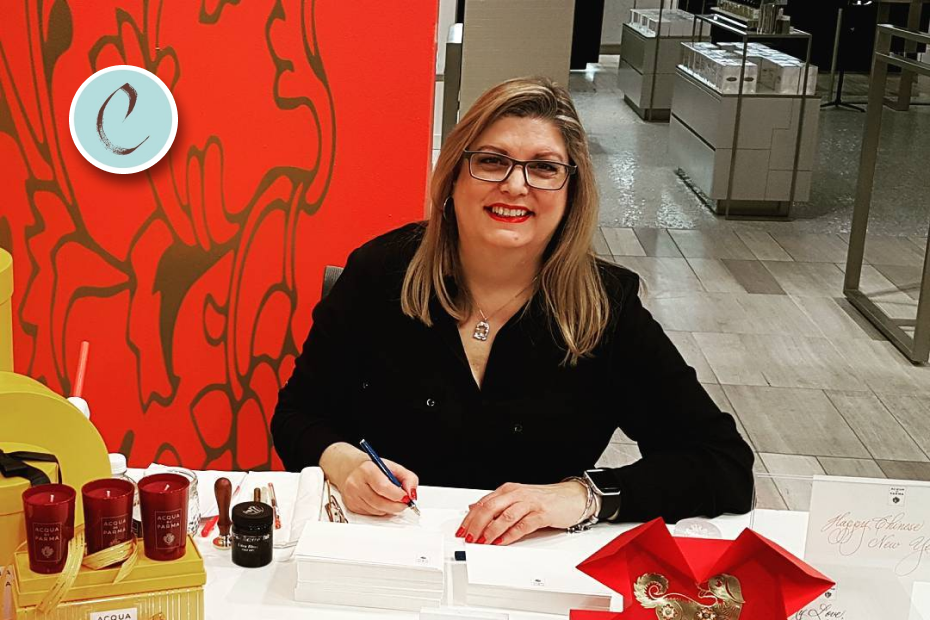
Diane Foisy letters wedding envelopes, corporate commissions and gift inscriptions from a one-person studio in the Greater Toronto Area, and she has been doing it since 1999. She also teaches. Both jobs take the same amount of time that posting to social media would have taken.
Her schedule survives that conflict because of one decision made early: which of her posts belong in a library that repeats, and which belong in a library that stops. This is how the sort works, what it produces, and where it does not apply.
Calligraphy by Diane Runs on a Portfolio That Does Not Expire
One-person calligraphy studio, running since 1999
Greater Toronto Area, Canada
Diane Foisy has run Calligraphy by Diane since 1999. She takes commissions for weddings and corporate clients, inscribes gifts and special-event pieces, and teaches calligraphy classes. One person does all of it. You can see the work at Calligraphy by Diane.
Diane’s offer mix is what makes her account worth documenting. A photograph of a finished set of place cards is as true two years later as it was the week she shot it. A class carries a date, and the date passes.
So one small business produces two kinds of posts that need two different treatments. RecurPost handles them differently, and choosing wrong is what produces a feed that keeps announcing an event nobody can attend.
Publishing Stopped Whenever a Commission Started
Diane published when she could step away from a commission. That was the trigger. No calendar set it and no queue held anything in reserve.
A one-person practice hits the same wall every time. The hour that produces the work is the hour that would have published about it, and the work is what gets paid for. Diane spent that hour at the desk, which is the correct call for a business paid to letter envelopes. Her profiles went quiet while she did.
Diane’s wedding season made the pattern obvious. Three weeks of envelope work meant three weeks with nothing published.
The Account Set a One-Person Studio Has to Keep Alive
Calligraphy by Diane publishes to a Facebook Page, an Instagram account, a LinkedIn profile, Pinterest and a YouTube channel. That is five destinations across five networks. RecurPost supports all five, along with X, Google Business Profile, TikTok, Threads and Bluesky.
Five destinations do not mean five connected accounts. RecurPost connects each Pinterest board as its own account, with its own queue, its own report and its own time zone. A calligrapher who keeps separate boards for wedding envelopes, corporate work, alphabets and class samples has four Pinterest accounts before anything else is connected. RecurPost bills against that count, so the boards decide the plan before the first post is written.
RecurPost’s publishing behaviour also changes with the account type. RecurPost publishes automatically to Instagram Business and Creator accounts and sends a mobile reminder to a personal profile instead. A personal profile therefore needs someone holding a phone at the scheduled minute, which is the one thing a working calligrapher cannot promise.
LinkedIn behaves better than most people expect. RecurPost publishes to a LinkedIn personal profile automatically through LinkedIn’s official API, the same way it publishes to a company page. No tap and no notification.
Sorting a Calligraphy Studio’s Posts Into the Right Library Type
RecurPost gives you three library types, and the sort between them is the decision this account turns on.
A recurring library publishes its posts in a continuous loop at the frequency you set, and it keeps going until you pause or delete the library. Seasonal libraries work on a date range instead. They publish inside the window, pause themselves when it closes, and reactivate when the next season comes round. The third type, one-time-use, retires a post once it has been published.
The deciding variable is not how old a post is. It is whether the post is still true after its publication date. A photograph of finished place cards stays true. A class on 14 June stops being true on 15 June.
RecurPost’s three library types map onto a calligraphy practice like this.
| Library type | What Diane’s practice puts in it | Why it belongs there |
|---|---|---|
| Recurring | Finished commission photography, alphabet and style samples, tooling and process shots, the answers she gives to the same client questions every month | None of it carries a date, so a reader who sees it in March and again in September gets accurate information both times. |
| Seasonal | Wedding-season envelope work, holiday gift lettering, a beginner’s course that runs the same weeks each year | The content is accurate inside a window and misleading outside it. A seasonal library enforces the window automatically. |
| One-time-use | A specific class date, a market or fair appearance, a single announcement | The post is true once. Repeating it puts a past date back in front of the reader. |
RecurPost is explicit about the limit of its own feature. Recurring libraries do not suit dated promotions, news or time-sensitive offers, and those posts work better as one-time posts. A studio that puts its class dates in a recurring library is using the wrong library type and not using the feature properly.
A recurring library also needs enough distinct posts that the gap between repeats stays long. The fix for a thin library is more finished work in it, not a slower schedule.
The RecurPost features used in this workflow are the three library types above and the per-network publishing that sends each post to the right account.
What Diane Reported After Years on the Same Libraries
Diane reported higher engagement and a wider customer base after she adopted RecurPost. She published no figures, and RecurPost has published none on her behalf.
The proof this account offers is not a percentage. It is the calendar. By Diane’s account, she built her libraries once and has run the same set ever since, through every commission season, without rebuilding them.
Duration is a different kind of evidence than a first-quarter lift, and it is the kind this account can honestly offer. A workflow that a sole operator has not abandoned is a workflow that did not quietly stop working in month four.
A reader who needs a measured result before switching tools will not find one on this page. The other RecurPost case studies document customers who published figures.
When This Setup Fits, and When It Does Not
RecurPost’s recurring libraries fit a practice whose finished work photographs well and stays presentable. Diane’s does. A maker whose production hour and publishing hour are the same hour gets the most out of the arrangement, because the schedule keeps running while the maker is at the bench.
A business whose posts are mostly launches, offers and reactive commentary should not build its schedule on recycling. RecurPost says so about its own feature, and the sort in the table above is what that limit looks like in practice.
Studios that will not convert an Instagram personal profile to a Business or Creator account keep a manual step in the schedule. The mobile reminder still needs a tap, and a reminder that arrives while the owner is mid-commission is the problem the schedule was meant to solve.
New practices are the third case. A studio six months old has too few finished pieces to fill a library, and a thin library shows.
A practice that grows into a small team has a review route, with one limit that matters for this setup. RecurPost’s approval workflow, on the Agency plan, moves one-off posts through stages assigned to roles, where a reviewer approves, rejects or sends a post back. Library and recurring posts do not route through those stages, so a studio that runs mainly from recurring libraries reviews its posts before they go into the library, for example by sharing the library for feedback.
A recurring library removes the scheduling work rather than all of it. Connected accounts still need to be reconnected when their access tokens expire, and someone still has to add new finished pieces as they come off the desk. A library that is never topped up eventually shows its age.
Try RecurPost
RecurPost’s Personal plan covers 5 social accounts for $25 per month, and the Agency plan covers 20 accounts for $79 per month. A practice like Diane’s sits between the two once the Pinterest boards are counted as separate accounts.
5 social accounts, which covers a studio before the Pinterest boards multiply.
20 social accounts, for a practice running separate boards per commission type.
See RecurPost pricing for every plan and add-on with its unit price, or start a 14-day free trial and sort one library before you decide.
Calligraphy by Diane Case Study FAQs
Common questions about how RecurPost library types behave:
What happens to a RecurPost post after it publishes from a one-time-use library?
A RecurPost one-time-use post publishes once and then expires into a separate library named Expired Content, which sits at the bottom of your library list. RecurPost does not delete the post. You can open Expired Content, copy a post out of it and put it into another library if the content becomes relevant again.
How many posts should a recurring library hold before recurrence is switched on?
RecurPost recommends adding at least 20 evergreen posts to a library before enabling recurrence. Below that, the interval between repeats gets short enough for followers to notice. A calligraphy studio usually clears 20 without effort, because every completed commission is a post.
Does a RecurPost recurring library publish the identical caption every cycle?
A RecurPost recurring library does not have to repeat the same caption. RecurPost rotates caption variations and first comments, and individual posts can carry an expiration date so they leave the loop. Variations exist to keep repeated posts inside X’s duplicate-content rules.
When does RecurPost build the next day’s posts for a recurring library?
RecurPost builds the recurring queue once a day at 8:00 AM UTC and queues the following day’s posts from each library at the frequency set for it. A change you make to a library today therefore shows up in tomorrow’s queue rather than immediately.
Can RecurPost publish to a Facebook Page and a personal Facebook profile in the same way?
RecurPost publishes to a Facebook Page automatically through Facebook’s API. A personal Facebook profile and a Facebook Group publish through a mobile notification instead, because Meta retired automatic Group posting in April 2024 and no scheduler can post there unattended. A studio running a Page only, as most one-person practices do, gets the automatic path for every post.